
Quick answer: Cure gel polish for the time printed on that product’s current label using a compatible UV/LED nail lamp. There is no single universal time: formula, lamp wavelength and output, layer thickness, color and hand position can all change the result.
What determines gel polish curing time?
| Factor | What to check |
|---|---|
| Product formula | Use the brand’s time for the exact base, color or top coat. |
| Lamp compatibility | Match the lamp type and wavelength range stated by the product maker. |
| Layer thickness | Thick or pooled gel can cure unevenly; apply thin, controlled layers. |
| Pigment | Dense or dark colors may have different instructions from clear layers. |
| Hand position | Keep every nail inside the intended curing zone; cure thumbs as directed. |
If gel still feels wrong after curing
Do not keep adding random cure cycles. Check the product label, lamp compatibility, layer thickness and lamp condition first. A tacky inhibition layer can be normal for some products, while wrinkling, sliding or liquid pockets require removal and reapplication according to the instructions.
Build a compatible routine from the base and top coat collection, compare complete sets, and use the product label as the final authority for curing.
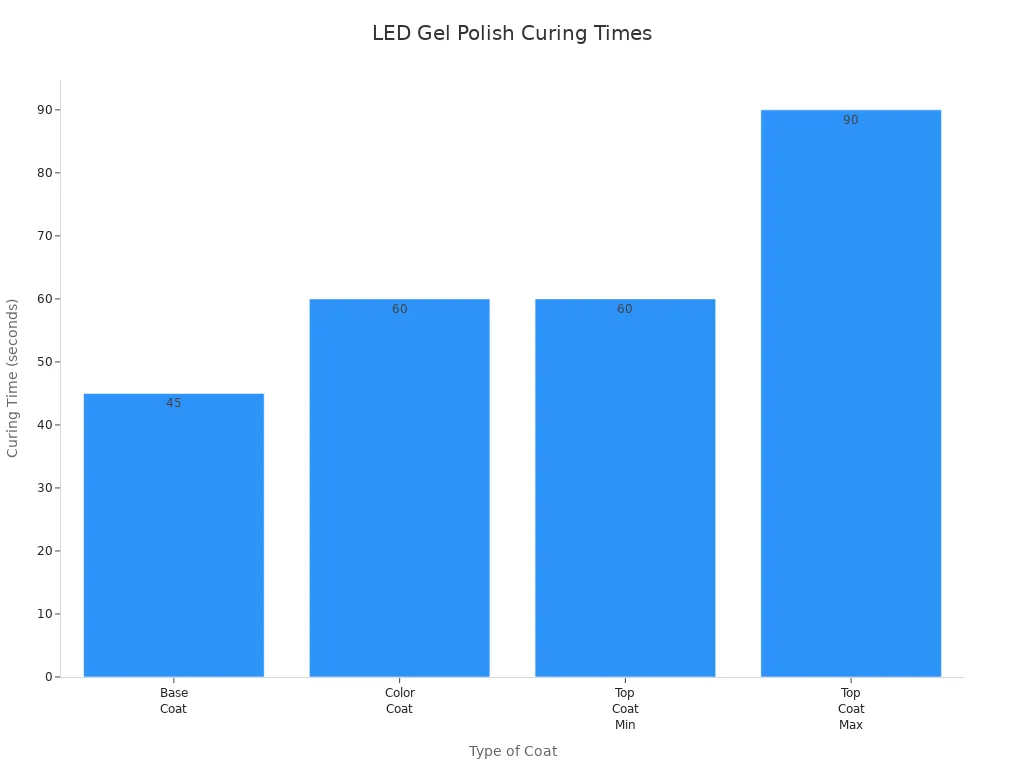
If you are trying to figure out how long should a gel polish be cured, then you need not worry because this is one of the reasons why the gel polish comes off or chippies earlier than required. The answer to how long should a gel polish be cured lies in your knowledge on how long should a gel polish be cured to get perfect looking nails. Here is how long should a gel polish be cured:
| Type of Coat | LED Curing Time | UV Curing Time |
|---|---|---|
| Base Coat | 45 seconds | 90 seconds |
| Color Coat | 60 seconds | 2 minutes |
| Top Coat | 60–90 seconds | 2 minutes |
As long as you follow all these tips on how long to cure gel polish, there won’t be any chipping or dulling of your nails. If you don’t do things correctly and just guess how long to cure gel polish, it can cause some issues. You need to know how long to cure gel polish for professionally looking nails.
Recommended next step
Use a Compatible UV/LED Curing Setup
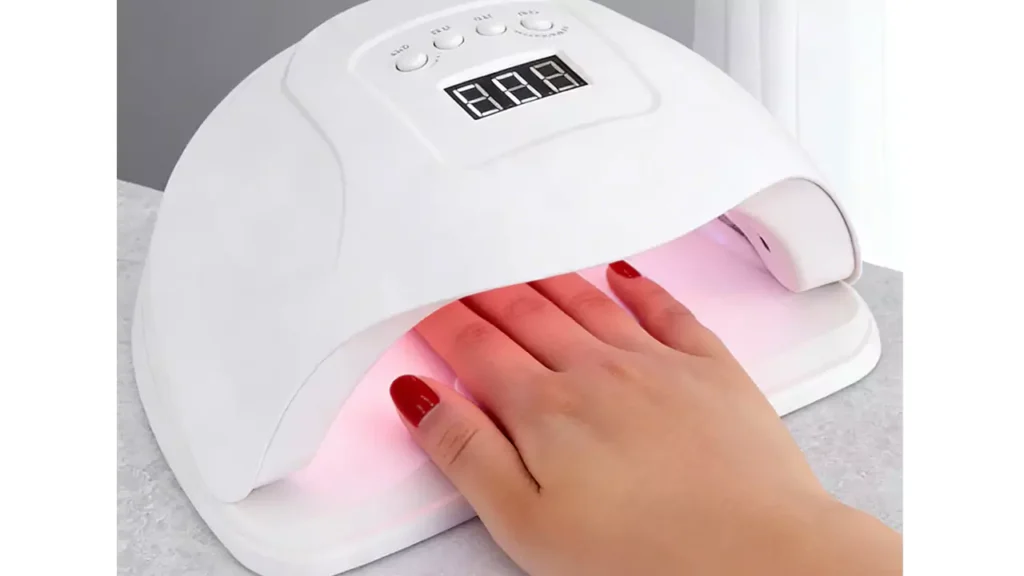
CHROMÉCLAIR gel polish and gel nail stickers require a compatible UV/LED nail lamp. Build the curing step into the complete routine instead of treating it as optional.
- Apply the compatible gel product in a controlled layer.
- Cure it under a UV/LED nail lamp according to the product label.
- Check the surface before continuing with the next coat or top coat.
Shop UV/LED nail lampSee handheld UV lampCompare all routines
Key Takeaways
- Ensure that each coat is cured properly and in accordance with the advised time period to prevent any issues such as chipping and peeling off. Use 45 seconds for curing base coat and 60 seconds for curing color coat under LED lamps.
- Remember to use thin layers while applying gel polish. It takes more time to cure thick layers of gel polish, and this causes lifting and wrinkling.
- Make sure to set a timer for every curing process. This allows you to maintain the drying time accurately, ensuring a long-lasting manicure.
- Know what lamp you are using. LEDs dry gel polish much faster than UV lights, which you should keep in mind when curing your manicure.
- Take note of whether your nails have dried correctly. They will be smooth, solid, shiny, and free of air bubbles.
How long to cure gel polish under LED and UV lamps
Curing Times for Base Gel, Color, and Top Gel Coats
If you wish to have a durable gel manicure, the most important aspect would be to understand the curing times for each coat of gel polish. For the base gel, color gel, and top gel coats, there is required curing time that cannot be overlooked.
Here’s a quick table to help you remember the best curing times:
| Coat Type | LED Curing Time | UV Curing Time |
|---|---|---|
| Base Coat | 45 seconds | 90 seconds |
| Color Coat | 60 seconds/layer | 2 minutes/layer |
| Top Coat | 60–90 seconds | 2 minutes |
You should follow these times for every layer. If you skip or shorten the process, your polish might stay sticky or peel off too soon. When you stick to the right timing, you get nails that look shiny and last longer.
Differences Between LED and UV Lamps
It is natural for you to ask what significance this lamp holds. Both LED and UV lamps cure gel polish. However, the process of curing is quite different with both types of lamps. An LED lamp uses a limited spectrum, while a UV lamp uses a wide spectrum.
Here’s a simple comparison:
| Type of Lamp | Curing Time | Wavelength Range |
|---|---|---|
| UV Lamp | Slower | 320 to 400 nm |
| LED Lamp | Faster | 370 to 380 nm |
With an LED lamp, you will complete your manicure faster. If you have to cure your nails using a uv light, then you should allow more time for every coat. Depending on the lamp used, the curing time varies; hence, one should check the lamp being used before applying any product.
Why Exact Drying Times Matter
Maybe you feel like a few seconds don’t matter, but they do. That is why you must stick to the exact curing times for each layer and lamp:
Curing correctly prevents you from having tacky or sticky nails.
Each layer takes its unique amount of time due to differences in viscosity, formula, and light sources.
Insufficient curing can lead to lifting and chipping of your nail polish.
Excessive curing results in the polish becoming very hard and causes it to not stay on your nail anymore.
Inconsistency with the proper schedule can result in larger complications. It may lead to chipping, peeling, and discoloration. Skin irritation and allergies are common if the polish is not dried properly. Dusting due to poorly cured nails can lead to inflammation and even the loss of your nail.
TIP: Set a timer for each coat. This will help you keep track of how long you need to cure the gel polish and give you perfect-looking nails.
If you do everything correctly, you’ll have beautiful, durable nails. You’ll be free from all kinds of issues like chipping and peeling. This is why understanding how long to cure gel polish is so important.
Why curing time affects lasting gel nail polish
Durability and Shine
You will want your gel nails to appear shiny and remain that way for many weeks. This is possible only when you cure each layer of the gel nails for the correct curing time period. What importance does this have? The curing process fixes the color of the nail and gives strength to the nail. When it is done incorrectly, you will face some issues.
- Proper curing time solidifies the gel and locks in the color, leading to a durable and glossy finish that can endure daily wear.
- Insufficient curing can result in peeling or chipping, while excessive curing may cause brittleness or discoloration.
- A glossy finish after curing shows that the gel polish is fully set, while a dull surface means you need more time under the lamp.
A proper curing process initiates a reaction known as polymerization that results in the hardening of the polish. If the process is not done right and the timings are not accurately gauged, there is a possibility that the polish will peel off or appear dull.
Nail Health and Safety
However, when getting your nails done, you may never think about their well-being. Scientific evidence proves that prolonged exposure to UV lights can be detrimental to both nails and skin. For example, a relatively safe period of time would be four minutes. Longer periods of UV light can lead to cellular damage and even increase the risk of developing skin cancer.
In case your nail polish is not cured well, there may be uncured chemicals left behind that can come into contact with your skin, causing allergies. This will cause some to experience symptoms such as itching and redness. Others might end up losing their nail plates because of weakened nails. Such problems can be avoided by curing your nail polish adequately.
Preventing Chipping and Peeling
Your manicure should be lasting; therefore, avoid chips and peels within a few days. The only secret to having this is the curing process. When thick coats are used, when curing time is short, and when one does not cap the free edge, the chances of the polish lifting up or chipping are increased.
Chipping and peeling could also result from thick coats, inadequate curing, and failure to cap the free edge during the application of the gel polish.
When one takes time curing his or her gel polish properly, the outcome will be perfect nails.
Risks of incorrect curing: under or over-curing gel nail polish
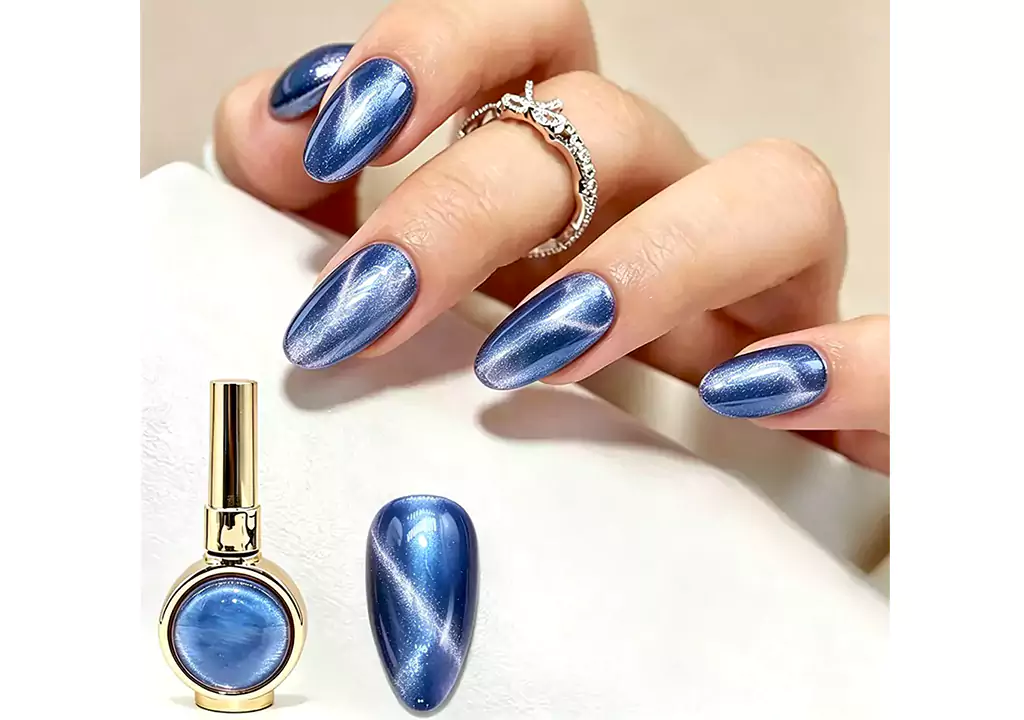
Signs of Under-Cured Gel Polish
Your nails may seem perfectly cured right after curing, but not properly curing your nail polish means you will have obvious signs soon after. Not leaving your gel long enough to cure can make you regret spending time doing your nails.
- There will be wrinkling on top of the cured polish.
- You may spot bubbles underneath the cured polish.
- Your nails will feel bumpy due to too much gel polish.
If you notice any of these problems, then your gel polish hasn’t cured completely, and you will have to correct this problem before applying further layers.
Pro tip: Make sure that you apply thin layers and cure them for the prescribed time period. That will help you avoid these common problems.
Problems from Over-Curing
You may assume that having your nails exposed to the light for slightly more time will be okay. Well, it won’t. Excessive curing will be just as bad as insufficient curing. These are some things that could happen when you over-cure your nails:
- They will become too dry and fragile.
- The gel polish will begin to peel off the nail plate.
- The color of the polish will fade or turn out unevenly applied.
What happens is that by over-curing, the gel becomes too rigid. It is unable to stay flexible and attach to your nail properly. If you want the manicure to remain on for longer, you should make sure you are not over-curing your nails.
Impact on Nail Longevity
Incorrect curing doesn’t just mess up how your nails look right away. It also affects how long your manicure lasts. If you don’t cure your gel polish the right way, you’ll notice problems sooner than you think.
- Under-cured layers stay soft and unstable. They peel off fast.
- Thick coats stop the light from reaching every layer. This leaves a soft spot next to your nail.
- Skipping the right curing time makes your manicure weak. It won’t last as long.
If you want strong, beautiful nails that last, you need to cure your gel polish just right. Following the right timing keeps your manicure looking fresh and helps you avoid chipping, peeling, and other problems.
Factors that change how long gel nail polish takes to dry
It is possible that you may ask yourself why your gel manicure either dries quickly or takes ages to dry. Here are some considerations which determine this. For you to be able to understand how long it takes for gel nail polish to dry, there are a number of issues you need to consider.
Lamp Wattage and Type
The drying time varies depending on your lamp. There are lamps available in various wattages, which have an effect on the drying time of gel nail polish. Those with low wattage will be slow and may fail to provide proper curing, leaving the nails soft. The high wattage ones are fast, although they may heat up when rushed.
| Wattage Level | Curing Time | Potential Issues |
|---|---|---|
| Low | Longer (UV: ~2 min, LED: >30 sec) | Under-cured nails, soft and damageable |
| High | Faster | Heat spikes, uneven curing, risk of damage |
The right lamp would be one which has the entire range of wavelengths from 365 to 405 nm. This will allow curing of all types of gel in an effective manner. The best lamps for home use are those ranging from 24 to 36W. There are mini lamps for travel, medium size for one-hand operation, and large lamps for two hands.
Gel Formula and Color
The composition and coloring of the polish you use also affect the drying process. Certain gels require additional curing due to their high level of energy consumption, which may vary according to the mixing of different gel brands. Variations in the curing process may result in some nails becoming harder than others. Gel with dark color or pigments requires more time for curing or an enhanced intensity of light to do so effectively.
- Lamps should have sufficient wattage depending on your gel polish.
- Always use one brand of gel polishes including the base coat, top coat, and color.
- Dark colored gels require a bit more time.
- Always apply a thin coat of the gel.
Application Thickness
The application process is equally important as the lamp and the polish. Thick applications mean it will take longer to dry, causing it to chip or peel. Thin applications mean quicker drying time and smoother application. When thick applications are used, you run the risk of having wrinkled nails. To avoid wrinkling and peeling, apply a thin layer, leaving space from your cuticle area.
- Thin layers are essential for proper curing.
- Thick layers require more time and may lead to issues.
- It is important to allow every layer to dry completely before applying another one.
Considering all these points, you will understand precisely how much time it takes for gel nail polish to dry. This way, you’ll achieve better results.
How to ensure exact drying times for gel nail polish
Tips for Proper Curing at Home
The first thing that you should do is to follow the correct procedure in order to achieve perfection with regard to your nails. It is important that you take care in order to ensure that your gel manicure stays in good condition for long. So why is all of this important? Here is how you can succeed:
- Before you begin, clean and file your nails.
- Buff your nails and get rid of the shine.
- Push your cuticles back to ensure that the gel coats just your nails.
- Wipe your nails using alcohol to remove the oils present.
- Put an even and thin layer of gel base coat on your nails. Thick layers cure slower and might have difficulties.
- Cover up the free edge of your nails with each coat. This is to prevent the polish from lifting.
- Cure your nails under the lamp for the specified period of time. Do not estimate the time; set a timer instead.
- Remove any gel that is on your skin before curing the layers.
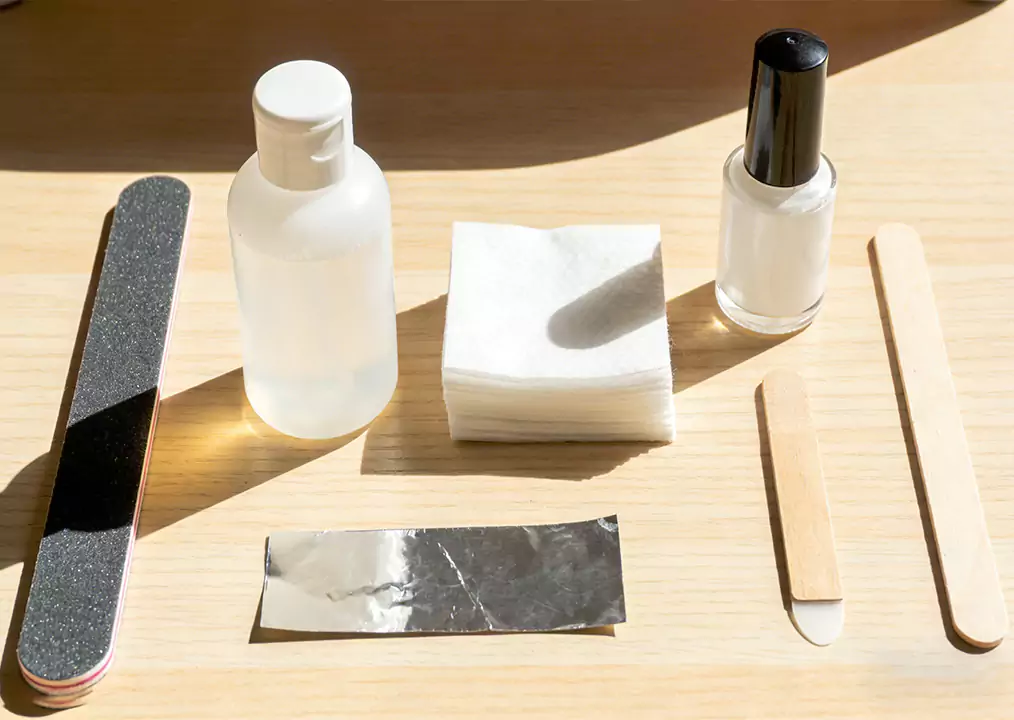
Tip: Always follow the instructions for your lamp and polish. This helps you hit the exact drying times and avoid mistakes.
How to Check If Gel Is Fully Cured
You want to know if your gel polish is ready. Here’s how you can tell:
- The surface feels smooth and hard, not sticky or tacky.
- The color looks shiny and even.
- There are no bubbles, wrinkles, or soft spots.
- The polish does not move or dent when you tap it gently.
If you see any of these signs missing, you may need more curing time. It’s better to check after each layer than to fix mistakes later.
Quick Reference Table for Curing Times
You don’t want to guess how long to cure each layer. Use this table to remember the best drying times for your gel nail polish:
| Coat Type | LED Lamp Time | UV Lamp Time |
|---|---|---|
| Base Gel Polish Coat | 45 seconds | 90 seconds |
| Gel Polish Color Coat | 60 seconds | 2 minutes |
| Gel Polish Top Coat | 60–90 seconds | 2 minutes |
Why use a table? It helps you avoid common mistakes like under-curing or over-curing. When you follow these drying times, you get strong, shiny nails that last.
You definitely want the longevity and beauty of your manicure. This is why you must adhere to the correct curing times for normal gel nail polish. Why? Because:
- Correct curing gives you an enduring, chiplees finish.
- Not adhering to proper steps will give you peeling or chipped nails, or worse, an allergic reaction.
- Over curing your regular gel nail polish will make it fragile and difficult to take off.
- The proper timing is key to the correct photochemical process.
Always make sure to read your lamps and gel nail polish directions. By curing your layers correctly, you can ensure that not only are you safe, but you also look great. You can have professional-grade nails without even going to the salon!
FAQ
Why do you need to cure each layer of gel nail polish for a set number of minutes?
You need to cure each layer for the right number of minutes because this locks in the color and strength. If you rush, the gel nail polish stays soft. If you wait too long, it gets brittle. The right minutes make your manicure last.
Why can’t you just cure gel nail polish for extra minutes to be safe?
You might think more minutes means better results. That’s not true. If you cure for extra minutes, the gel nail polish can crack or peel. The formula works best when you follow the recommended minutes for each layer.
Why does the lamp type change how many minutes you cure gel nail polish?
Different lamps use different light. LED lamps cure faster, so you need fewer minutes. UV lamps take more minutes to cure each layer. Always check your lamp and follow the right minutes for the best results.
Why does curing for too few minutes cause problems with gel nail polish?
If you cure for too few minutes, the gel nail polish stays sticky or soft. This makes it chip or peel fast. You want to cure for the full minutes so your nails stay strong and shiny.
 English
  Spanish
  German
  French
  Italian
  Dutch
Dutch