
When pigment suppliers upstream of the coatings supply pigments, each pigment has its corresponding CI index number. When downstream coating customers request specific colors, each color also has its corresponding Pantone index number. Both the CI index and Pantone index are used to distinguish colors, so what are their differences and connections?
01 Dyes and Pigments
Dyes are coloring agents with strong tinting or fluorescent effects that impart color to materials by selectively absorbing light.
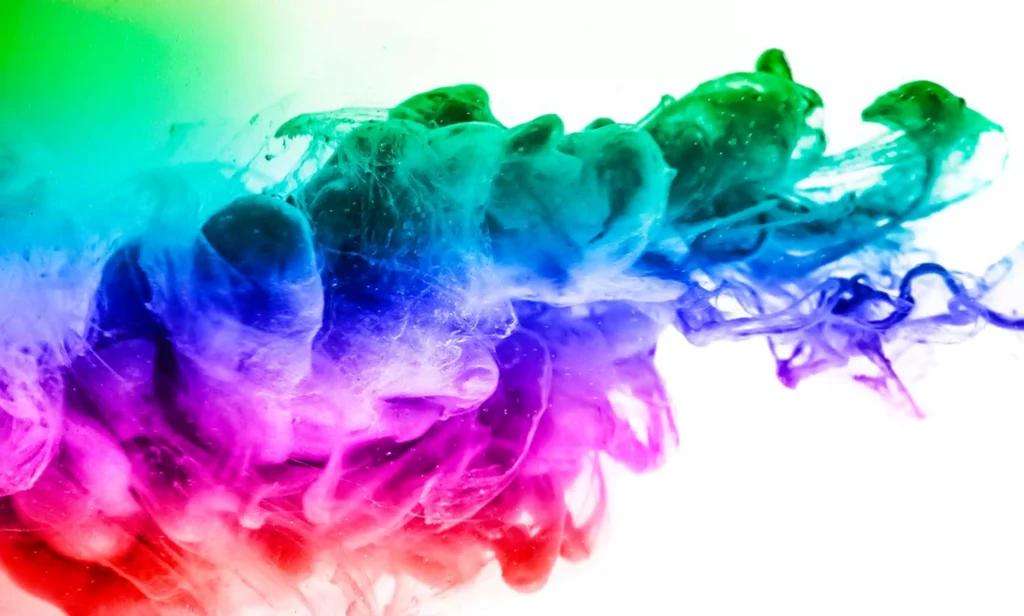
Soluble in water or organic solvents, they exhibit affinity for the substrate, attaching via ionic or hydrogen bonds to impart color with certain dyeing fastness. Primarily used in textiles, leather, food, cosmetics, and other fields.
Pigments are insoluble particulate colored substances that provide color effects by selectively absorbing or scattering light, maintaining their crystalline or granular structure throughout the coloring process.
Recommended next step
HEMA/TPO-Free Starter Routine
First time trying CHROMÉCLAIR? Start with a small, compatible routine instead of one random bottle.
- Choose a HEMA/TPO-free color or set.
- Pair it with a compatible base and top coat.
- Use the same system for a smoother first manicure.
Shop starter routine kitStart with UV1 7PCSCompare all routines
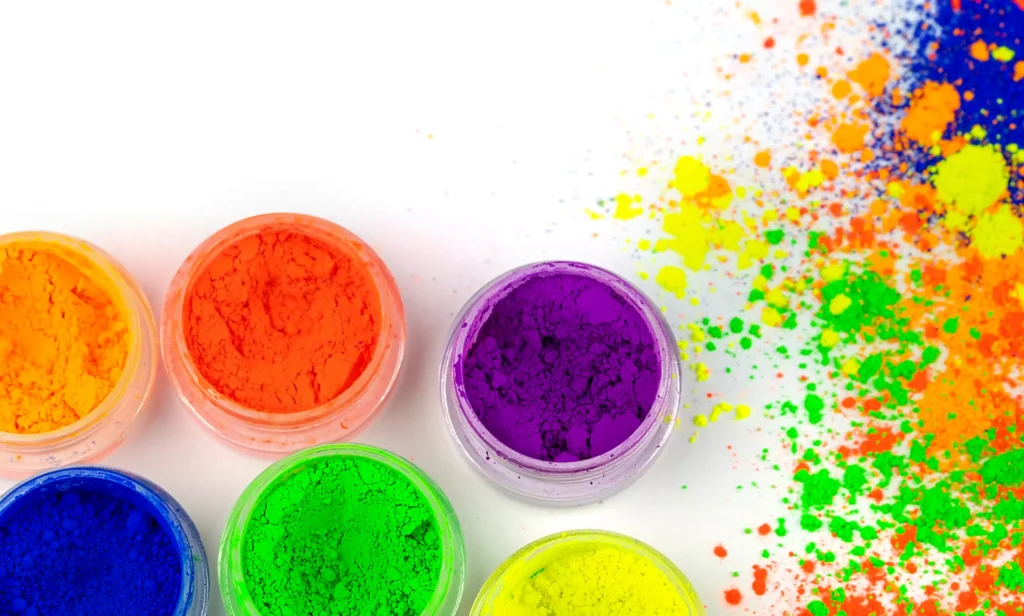
Pigments are typically dispersed in a carrier or substrate for application, such as in the manufacture of paints, inks, plastics, and similar products.
02 Pigment (or Dye) Index
The Colour Index (CI) is a standardized classification system for the global dye and pigment industry. Jointly published and maintained by the Society of Dyers and Colourists (SDC) in the UK and the American Association of Textile Chemists and Colorists (AATCC) in the US, it aims to resolve confusion in commercial nomenclature and achieve standardized management of colorants.
1) Colour Index Generic Name (CIGN)
CIGN describes commercial products through its recognized application category, hue, and serial number. The naming format is: CI + Application Category + Color + Serial Number. The application category identifies the type of colorant, such as Pigment or Vat (reduction dye). The color identifies the basic hue of the colorant, such as Yellow, Red, or Black. The serial number identifies the registered sequence number of the pigment. Pigment products sharing the same designation possess identical chemical structures in their pigment components.
Naming Examples: C.I. Pigment Yellow 1, C.I. Pigment Yellow 3, C.I. Pigment Red 3, C.I. Pigment Black 11. These names are sometimes abbreviated directly as PY 1, PY 3, PR 3, PB 11. Both Pigment Blue and Pigment Black are abbreviated as PB. To avoid confusion, the blue pigment is abbreviated as PB, while the black pigment is abbreviated as PBk.
2) Color Index Constitution Number (CICN)
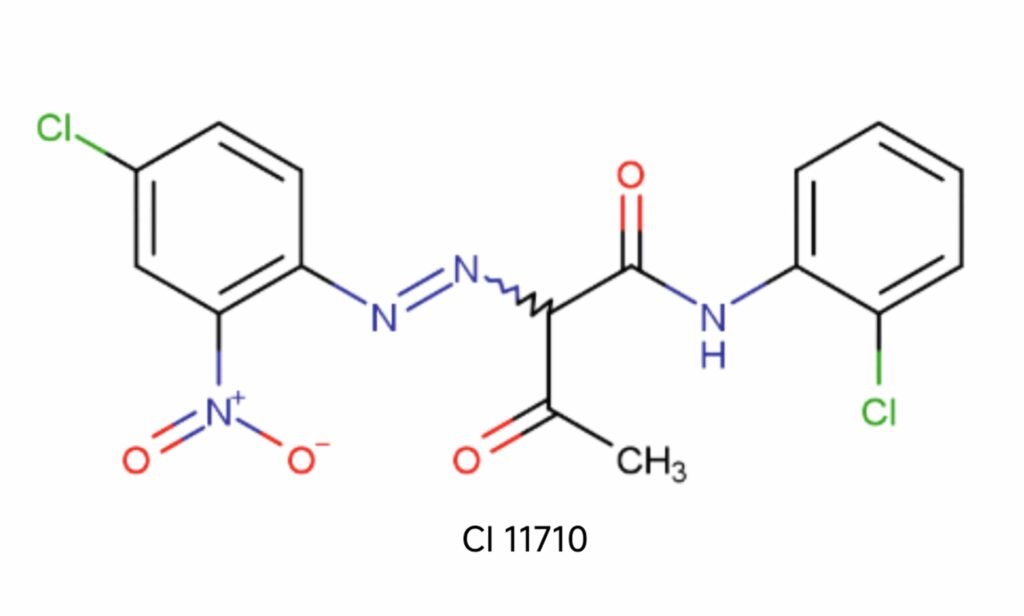
For some pigments whose chemical structures have been published, they will be given a five-digit number. For example, PY 1 corresponds to CICN 11680, and PY 3 corresponds to CICN 11710. The structures of the pigments corresponding to CI 11680 and CI 11710 are shown in the figure below.
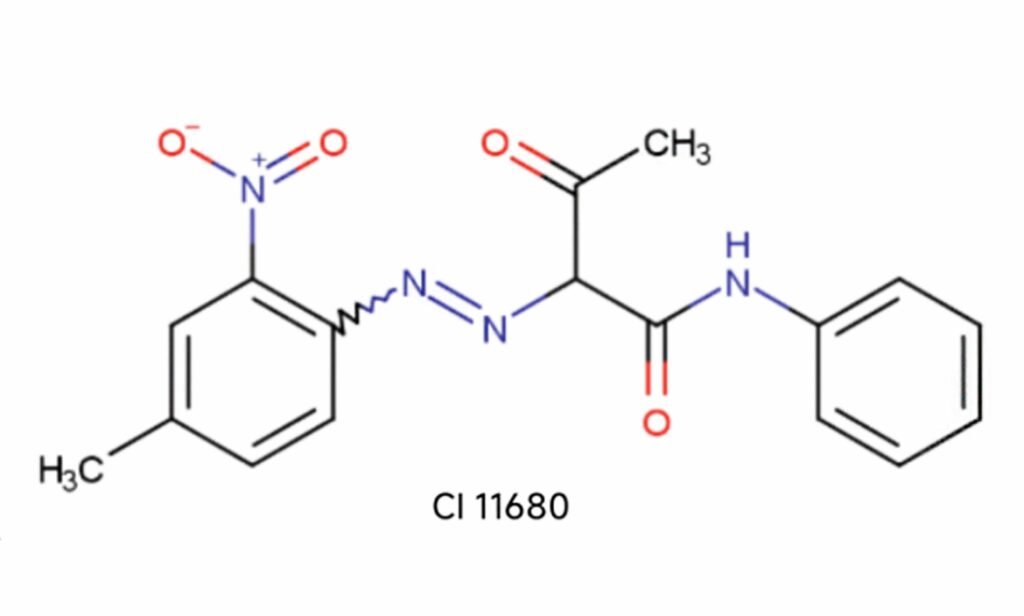
By 1997, with the proliferation of colorants featuring diverse chemical structures—particularly monoazo dyes—the five-digit CI numbers appeared insufficient. Consequently, the CI numbering system was expanded to six digits. For instance, the CICN number for Bismuth Vanadate Yellow (PY 184) is 771740.
3) Colon Designation
A colon “:”is used to denote minor variations in pigment numbers, such as Phthalocyanine Blue PB 15, PB 15:1, PB 15:2, and PB 15:3. Their corresponding CICN numbers are 74160, 74160:1, 74160:2, and 74160:3. These indices denote pigments with identical or nearly identical chemical structures but differing crystal forms.
PB 15 exhibits the fundamental α crystal form, displaying a red-phase blue hue. However, this form is unstable and transforms into the β phase under high temperatures or in solvents, causing color phase shifts. PB 15:1 is a stable α-phase form. Partial chlorine atom substitution enhances α-phase stability, preserving the red-phase blue color and reducing tendency for phase transformation. PB 15:2 is an amorphous α-phase form. Resin surface treatment disrupts crystallinity, improving dispersion and anti-flocculation properties. PB 15:3 is the most common form in coatings. It is a β-phase form exhibiting a green-phase blue color. This phase is the most stable, offering excellent weather resistance and heat resistance.
03 Pantone Index
The Pantone Index refers to the Pantone Matching System (PMS) and its associated color swatches, libraries, and tools. The Pantone Index is a vast, standardized color reference library that assigns a unique number to each color. It is the most widely used and authoritative spot color matching system in the world.

The Pantone index provides a unified and standardized color communication language for designers, manufacturers, printers, brands, etc. When a designer specifies a Pantone color number (such as “Pantone 277 C”), printing plants, fabric suppliers, paint manufacturers, and others worldwide can locate the exact same color based on this standard number for production, ensuring color consistency.
Pantone’s core lies in spot colors. Spot colors are produced using pre-mixed specific inks (or dyes, paints) rather than simulated through the overlay of CMYK four-color halftones. Spot colors offer greater accuracy, vibrancy, and consistency, unaffected by printing press settings or monitor variations. They are particularly suited for applications demanding precise color matching, such as brand identity colors and iconic packaging. For example, Pantone 277 C in the Pantone color guide is formulated using the following three inks in the specified ratios:
PANTONE Pro. Blue 3.42
PANTONE Violet v.2 1.69
PANTONE HD Ext. 94.89
The Pantone Index covers virtually every field requiring precise color control, such as graphic design and printing, textiles and apparel, plastics, coatings, inks, and product design.
04 Differences Between CI Index and Pantone Index
The CI Index targets pigments or dyes, assigning a unique number to each colorant based on its chemical structure.
The Pantone Index is designed for colors, assigning a unique number to each color within the Pantone Matching System. These colors can be the hue of a single pigment or dye, or a color created by mixing multiple single-color materials in specific proportions. Since Pantone uses a limited number of base colors, the vast majority of entries in the Pantone Index are shades created by mixing these base colors.
 English
  Spanish
  German
  French
  Italian
  Dutch
Dutch